
Abortion Pills
Safe Medical Abortion: A Guide by Dr. Shalini Sankhwar
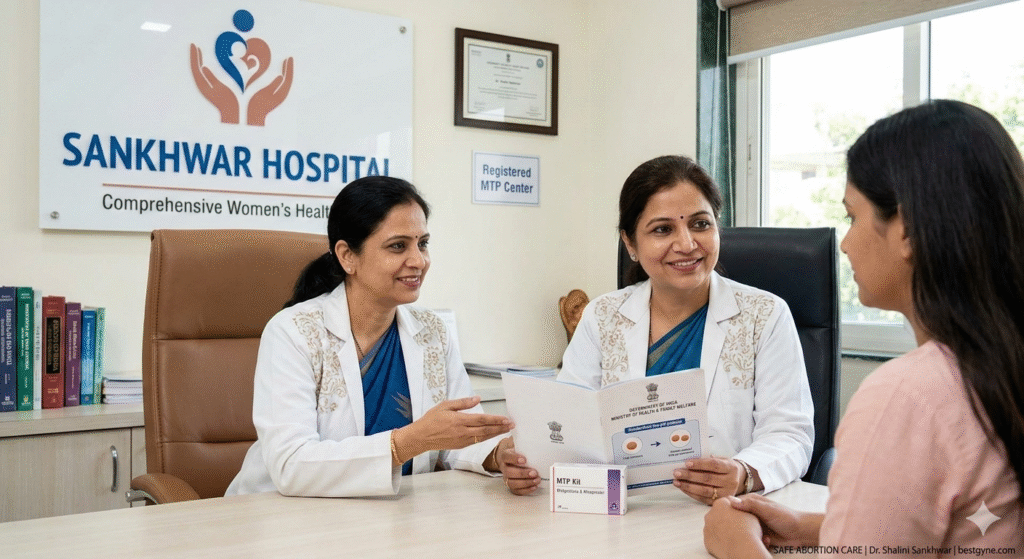
When facing an unplanned pregnancy, your safety and health are the highest priorities. At Sankhwar Hospital, led by Dr. Shalini Sankhwar, we provide a trusted environment for Comprehensive Abortion Care . It is vital to remember that medical abortion should only be performed under the supervision of a Registered Medical Practitioner (RMP) only at a registered MTP center.
Why Trust a Registered Gynaecologist?
Abortion is legal in India under the MTP Act, but it must be performed within specific legal and medical frameworks. Using “over-the-counter” pills without a prescription is illegal and dangerous. An Experienced and certified gynaecologist ensures the procedure is safe, effective (95–99% success rate for early pregnancy), and tailored to your health needs.
1. Essential Medical Investigations
Before prescribing M T Pills or any other Abortion drugs, certain investigations are mandatory to ensure your safety:
- Confirmation of Gestation: A Lower Abdomen Ultrasonography (USG) is used to confirm the pregnancy is within the 7-week (49 days) limit and is not an ectopic pregnancy.
- Haemoglobin (Hb) Test: To rule out severe anaemia.
- Blood Grouping (ABO & Rh): Specifically to check if the patient is Rh-negative, which requires an Anti-D injection.
- Urine Analysis: A routine check for general health.
2. Who Should NOT Take Abortion Pills (Contraindications)
Medical abortion is safe for most, but it is strictly contraindicated for patients with:
- Confirmed or suspected ectopic pregnancy (pregnancy outside the uterus).
- Severe Anaemia (Hb <8 gm%).
- Uncontrolled Hypertension or serious heart, liver, or kidney diseases.
- Chronic Adrenal Failure or long-term systemic corticosteroid therapy.
- Known Allergy to Mifepristone or Misoprostol.
- Pregnancy with an IUCD in situ (the device must be removed first).
3. How to Take MTP Pills: The GoI Protocol
The standard Government of India protocol involves a minimum of three visits to your gynaecologist:
| Visit | Day | Procedure |
| First Visit | Day 1 | Mifepristone (200mg) is taken orally in the clinic. This stops the pregnancy from growing. |
| Second Visit | Day 3 | Misoprostol (400mcg) is administered (sublingual, buccal, or vaginal). This causes the uterus to contract and expel the pregnancy. |
| Third Visit | Day 15 | Follow-up visit to confirm the abortion is complete via clinical exam or USG. |
Pain Management: For cramping, Tablet Ibuprofen is recommended. Paracetamol is NOT recommended for pain relief during this process.
4. Warning Signs: When to Contact Us Immediately
Most patients experience bleeding heavier than a period for 8–13 days. However, seek immediate medical help if you experience:
- Excessive Bleeding: Soaking two or more thick pads per hour for two consecutive hours.
- Persistent High Fever or foul-smelling vaginal discharge.
- Severe Abdominal Pain that does not subside with medication.
- Fainting or Dizziness.
Your Health, Your Choice, Your Safety
At Sankhwar Hospital, we provide confidential care and discuss all post-abortion contraception options to help you plan your future.
Dr. Shalini Sankhwar is an expert Gynaecologist with more then 20 years of eperience,
In her vast career she have performed all challenging abortions like abortion after 2 previous cesareans, placenta previa etc.